
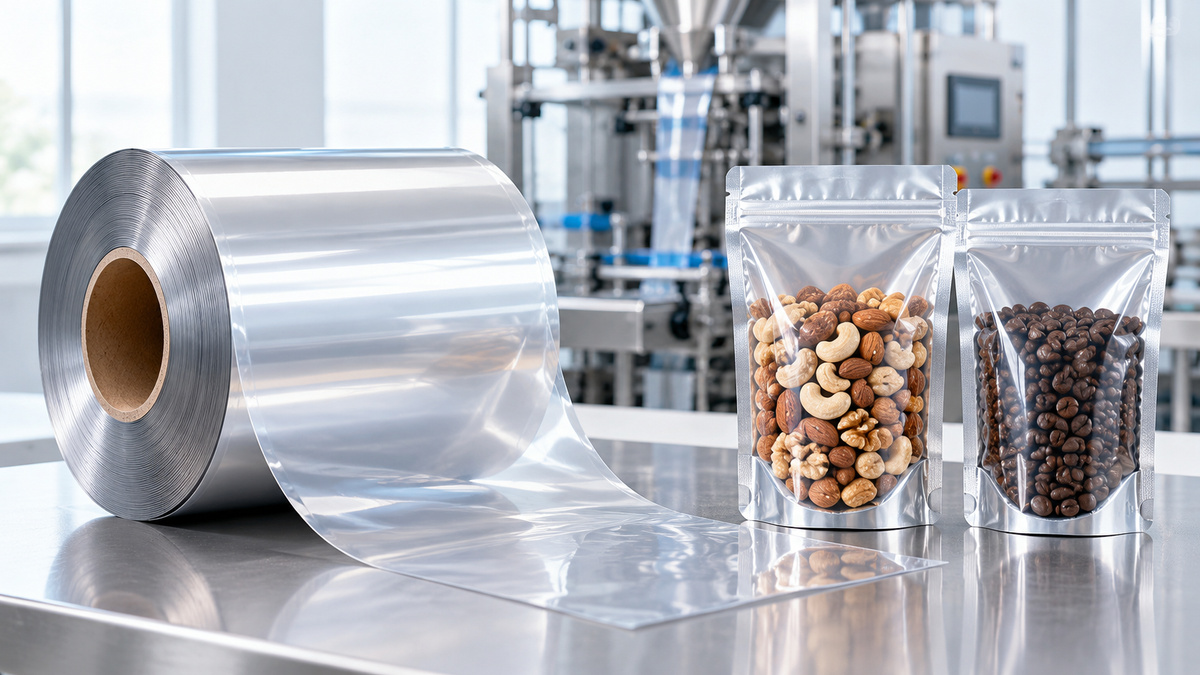
Why High Barrier Rollstock Must Suit the Packaging Machine
See why high barrier rollstock selection needs both barrier data and line trials, including seals, forming damage and stable automatic packaging.
High barrier rollstock is often compared through oxygen and water-vapour transmission values. Those figures describe important material properties, but they do not show whether the film will form a sound package on a particular machine. Selection needs to connect barrier protection with the way the rollstock is processed.
Match Barrier Protection to the Product
Foods respond differently to oxygen and moisture. The required structure should follow the contents, filling method, storage conditions and shelf-life target. More barrier is not always the only issue; the finished pack must also keep its seals and remain intact through distribution.
OTR and WVTR should be read with the test method, temperature, humidity and film thickness. Results measured under different conditions may not provide a meaningful comparison.
Forming and Converting Can Change the Result
Printing, lamination, folding and forming place additional demands on the material. A film with suitable flat-sheet barrier performance may still develop pinholes, cracks or bond problems during these stages.
For automatic packaging, stiffness and friction affect unwinding and forming, while the sealing window and hot tack affect pack release and downstream handling. These properties need to suit the machine, speed and seal configuration.
Include the Product at the Seal Area
Powder, oil or small fragments can reach the sealing area during filling. A trial using clean empty packs may miss that condition. Representative filling tests help establish whether the material and machine settings deliver consistent seals in actual production.
Separate Seal Leaks from Film-Handling Problems
For leaks, review jaw condition, pressure, contact time and seal contamination. For tracking or forming issues, check tension, roll edges, stiffness and friction. Distinguishing the failure mode makes it easier to decide whether settings, roll quality or the structure need attention.
Approve Rollstock Against Finished-Pack Performance
DY can review the current laminate, barrier targets, machine information and defect photos to discuss trial options. Assess the result through package integrity, accepted-pack yield and stable output, alongside relevant shelf-life checks. This gives a more complete basis for approval than a barrier figure alone.